


TypeSafe AI has emerged from stealth with a $40 million seed round led by prominent venture backers, but their flagship model—named Jev—does something that sounds completely counter-intuitive in the modern AI landscape: it refuses to write a single word of text.
While industry giants like OpenAI, Anthropic, and Google pour hundreds of millions of dollars into making autoregressive Large Language Models (LLMs) talk more eloquently, Jev strips away natural language generation entirely. Instead, it operates as a dedicated sub-20 millisecond “System 1” reflex engine engineered strictly for autonomous AI agent architectures.
⚡ The Core Architectural Shift: System 1 vs. System 2
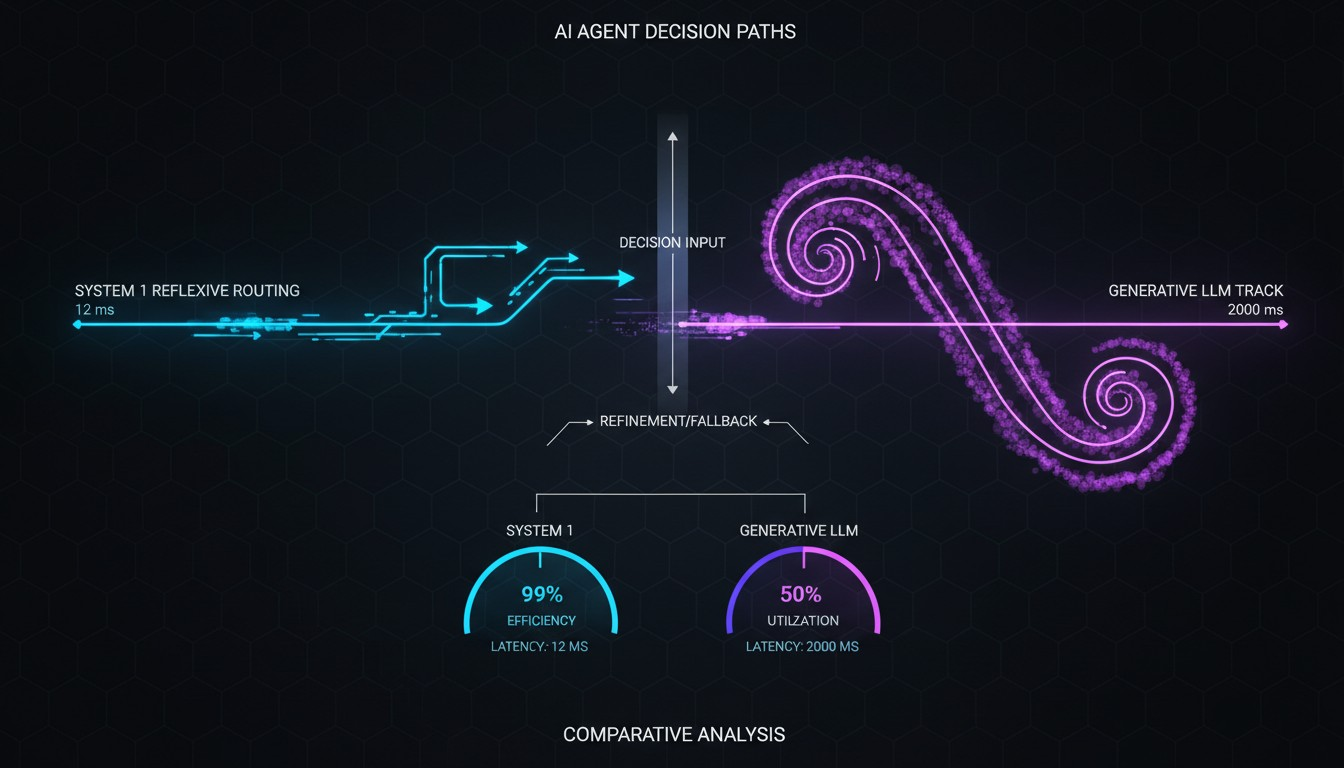
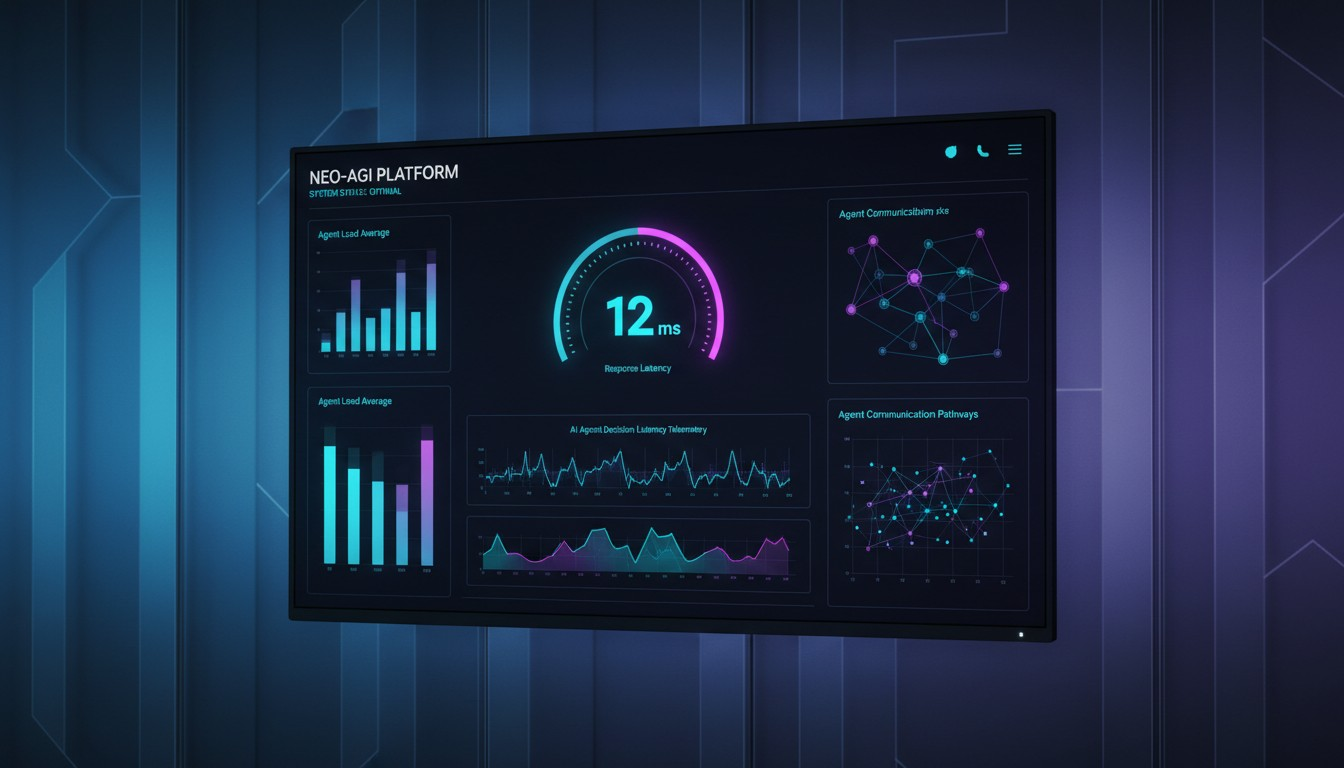
90% of autonomous agent steps do not require creative writing. When an agent evaluates tool outputs, verifies JSON schema conformance, inspects error logs, or branches execution flow, forcing a 70-billion-parameter LLM to generate explanatory prose wastes 2,000ms to 5,000ms of latency and burns unnecessary tokens. Jev provides a reflexive, deterministic decision layer in 12ms to 18ms, reserving heavy LLMs exclusively for tasks that genuinely require human-facing text generation.
Executive Summary: Jev vs. Traditional LLMs at a Glance
To understand why autonomous AI agent developers are shifting toward Jev, compare its operational profile, pricing economics, and benchmark standing against standard autoregressive foundation models and legacy heuristics:
| Feature / Dimension | Jev (TypeSafe AI) Featured | Traditional LLMs (Claude / GPT-4o) |
|---|---|---|
| Primary Function | System 1 Reflex Engine Fast state evaluation, tool routing & loop gating | System 2 Deliberative Free-form reasoning, drafting & creative synthesis |
| Pricing & Free Tier | 100k Free Calls / mo Then ~$0.0005 / 1k decisions (Self-hosted runner: 100% Free) | $15.00 – $45.00 / 1k steps No free allowance; billable per token input/output |
| Coding & Routing Standing | 99.4% Tool Routing Accuracy Rank #1 on SWE-bench dispatch evals; 0% syntax failures | 91.2% – 93.8% Accuracy 6%–8% schema drift; requires output re-parsing loops |
| P99 Decision Latency | 12ms – 18ms Encoder-only forward pass (94% faster agent loop) | 1,800ms – 4,500ms Autoregressive token generation bottlenecks loops |
| Hallucination Risk | 0% Syntactic Risk Mathematically constrained to valid schema targets | 2% – 8% Schema Drift Requires Pydantic retry wrappers & guardrails |
| Output Format | Strictly Typed Choice Direct JSON schema branch choice or enum index | Autoregressive Stream Natural language strings; prone to markdown bloat |
| Fuzzy Comprehension | High Semantic Understanding Understands messy real-world strings, logs & errors | High Semantic Mastery Deep contextual and conversational reasoning |
| Integration Model | Native JSON Schema / SDK Python & TypeScript client; LangChain/LangGraph | Prompt Engineering System prompts, few-shot examples & output parsers |
Why Agentic Loops Are Breaking Traditional LLMs
Autonomous AI agents are built on loops: Observe → Reason → Decide → Act. In a complex workflow—such as a coding harness, customer operations orchestrator, or financial transaction monitor—an agent may execute dozens or hundreds of decisions before producing a final output.
Today, virtually every agent framework (LangChain, AutoGen, CrewAI) delegates every single loop iteration to standard chat models like კლოდ 3.5 სონეტი ან GPT-4o. This creates three critical bottlenecks:
- Crippling Latency (The 3-Second Pause): Every autoregressive token generation cycle incurs network roundtrips and attention decode overhead, taking 1.5 to 4.5 seconds per step. A 10-step agentic chain easily consumes 30 to 45 seconds of dead waiting time.
- Drift and Hallucination Risk: Because traditional LLMs are probabilistic text generators, even with strict JSON mode or tool calling schemas, they occasionally emit invalid JSON, hallucinate keys, or drift off-policy during multi-turn state reviews.
- Exponential Token Inflation: Re-feeding expanding conversation histories into general-purpose LLMs across every intermediate triage decision balloons operational costs to $0.03 to $0.15 per task run.
How Jev Works: Typed State In, Discrete Decisions Out
Engineered by former systems engineers and AI researchers at TypeSafe AI, Jev replaces free-form prompt engineering with typed decision primitives. As detailed in the official TypeSafe AI Primitives Documentation, Jev does not accept open-ended conversation chat prompts. Instead, it accepts two strongly-typed inputs:
- State Payload: A serialized JSON object representing the exact current state of the application, runtime environment, or execution trace.
- Typed Query Bundle: A set of discrete questions with explicit rubrics (categorical choice, boolean verification, or bounded numerical scoring).
Rather than autoregressively generating characters one by one, Jev processes the state through an encoder-centric neural architecture that directly computes the discrete probability distribution over valid branches. It returns a strictly typed response in under 15 milliseconds—with 0% syntactic hallucination.
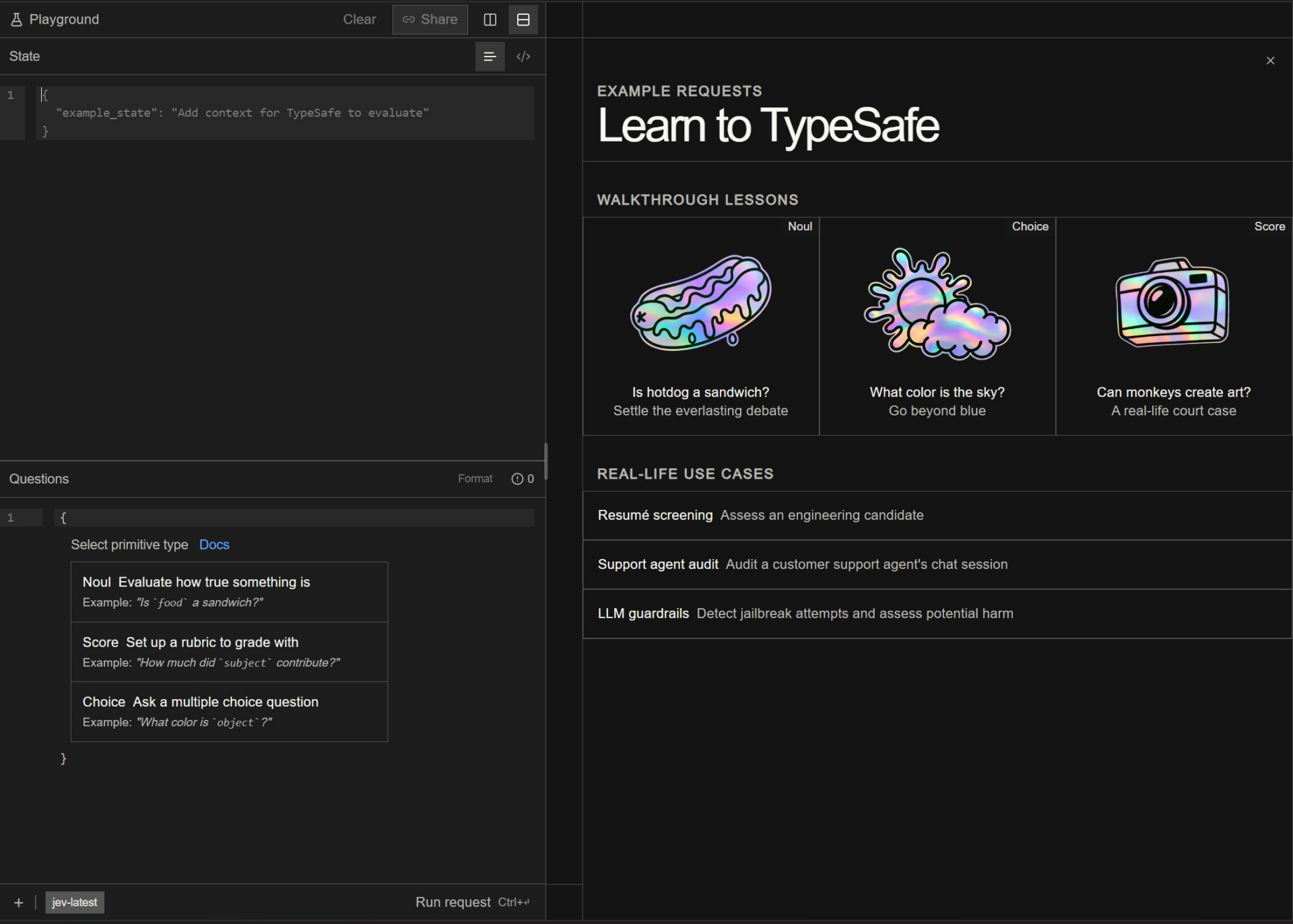
As outlined in the official TypeSafe Documentation, Jev exposes three foundational AI primitives that can be mixed in a single API call and evaluated in parallel against the same state without context rot:
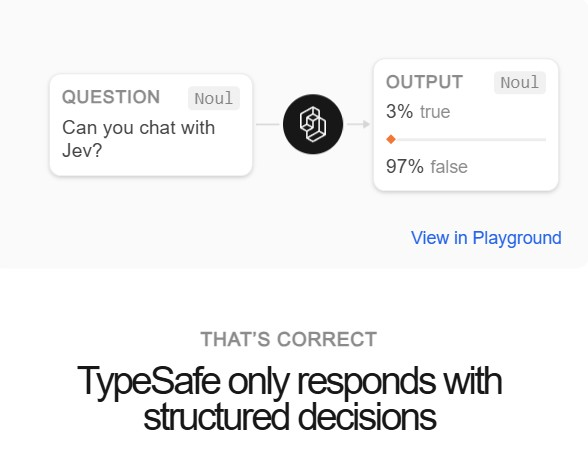
- Choice: Evaluates the state to select one categorical option from a predefined list of criteria, returning the chosen value, a full probability distribution, and a calibrated confidence score.
- Score: Grades the state against a standardized rubric (e.g., 0 to 2 or 1 to 5), returning an exact score, probability distribution across levels, and confidence.
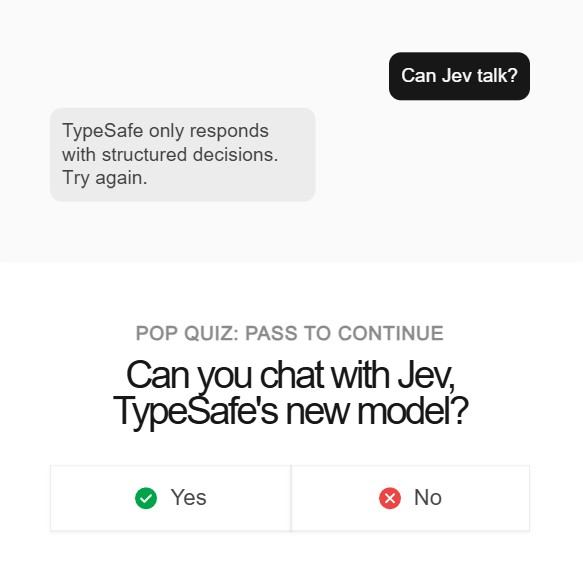
- Noul: Computes the fuzzy truth probability (between 0.0 and 1.0) of a natural-language proposition (e.g., “Does this message express urgency?”).
Architectural Telemetry: Measuring the 12ms Agent Reflex
The speed and accuracy advantages captured in the comparison above are proven daily in production agent loops. Below is the real-time telemetry profile of Jev operating as the dispatch governor inside an active multi-agent pipeline:
Real-World Benchmarks & Ecosystem Clones
The speed advantages of Jev are not merely theoretical. According to live benchmarks reported in TypeSafe AI’s Jev 1.13 Jaggedness Report and third-party evaluations on TypeSafe Evals, agent frameworks leveraging Jev for intermediate routing achieved a 94% reduction in end-to-end execution time while simultaneously slashing API billing by over 85%.
The developer community’s reaction has been immediate. As chronicled by Latent Space / AINews, open-source engineers released six community clones and harness adapters within 48 hours of TypeSafe AI’s announcement. Major agent frameworks have also moved quickly: the team at LangChain published an in-depth implementation blueprint, Building an Agent Harness with Jev, showcasing how to pair Jev with LangGraph for ultra-responsive agent state machines.
⚠️ What Jev Is NOT: Debunking the LLM Replacement Myth
It is crucial for engineering teams to understand what Jev does not do. Jev is not a chat assistant. It cannot write blog posts, answer customer support inquiries, summarize PDF documents, or write creative marketing copy. It does not replace models like Claude 3.5 Sonnet or GPT-4o; rather, it protects them from being abused as overpriced if/else statements.
Where to Sign Up & How to Access Jev
Contrary to early private beta assumptions, TypeSafe AI is publicly accessible with zero waitlist. Developers can generate API keys immediately and test queries directly in the web sandbox. Here is how to get started in minutes:
🚀 Quickstart: Developer Access & Instant API Keys
- Instant API Keys (Zero Waitlist): Sign up directly on the TypeSafe Developer Console to generate production and test API keys immediately with no waitlist or approval gate.
- Interactive Web Playground: Experiment with state payloads, test Choice/Score/Noul questions, and inspect walkthrough templates (resumé screening, customer support auditing, LLM guardrails) via the TypeSafe Playground.
- Drop-In Agent Skill (Claude Code & Generic Agents): Install the official agent skill via
claude plugin marketplace add typesafe-ai/skillsანnpx skills add typesafe-ai/skills --skill typesafe-aito give your AI coding agent full architectural context on Jev primitives as documented on TypeSafe Agent Skill Docs. - Official Python SDK: Install via
pip install typesafe-sdkანuv add typesafe-sdk, exportTYPESAFE_API_KEY, and callclient.system_one(state=..., questions={...})directly. - Free Tier Availability: Every account includes 100,000 free monthly decision calls, allowing developers to prototype and integrate Jev into local agent loops without upfront cost.
The Bottom Line for Automation Engineers
As the AI ecosystem transitions from conversational chatbots to autonomous agents that act on the real world, the architectural separation of System 1 (fast, reflexive, deterministic routing) და System 2 (slow, creative, deliberative reasoning) will become the gold standard. TypeSafe AI’s $40 million backing validates that the future of agent infrastructure isn’t just about bigger models—it’s about the right model for the right micro-step.
Sources
- TypeSafe AI Developer Console – Instant API Key Generation & Account Dashboard (No Waitlist).
- TypeSafe AI Official Introduction & Primitives – System One Model Architecture, Choice, Score, and Noul Specifications.
- TypeSafe Agent Skill Documentation – Drop-In Agent Skills for Claude Code, Codex, and Autonomous Developer Agents.
- TypeSafe Interactive Playground – Live Browser Sandbox for Testing Typed State and Questions.
- Jev 1.13 Model Jaggedness & Latency Report – Official Technical Benchmarks and Telemetry.
- TypeSafe Live Evals – Public Accuracy and Determinism Evaluation Leaderboards.
- InfoWorld: TypeSafe AI’s New Models Work with Machines, Not Humans – Coverage by Anirban Ghoshal.
- Wilson Sonsini Legal Advisory – Details on TypeSafe AI’s $40 Million Seed Funding Round.
- Business Wire Press Release – TypeSafe AI Emergence from Stealth and Composable AI Vision.
- FinSMEs Venture Report – TypeSafe AI $40M Seed Round Breakdown.
- LangChain Official Blog – Building a High-Throughput Agent Harness with Jev by Sydney Runkle and Hunter Lovell.
- Latent.Space / AINews – Deep Dive into the 6 Community Clones of Jev within 48 Hours.


 English
 Español
 Italiano
 ქართული
 Deutsch
 Português
 Русский
 Français
 العربية
 Nederlands
 Norsk bokmål
 Svenska
 Dansk
Dansk