

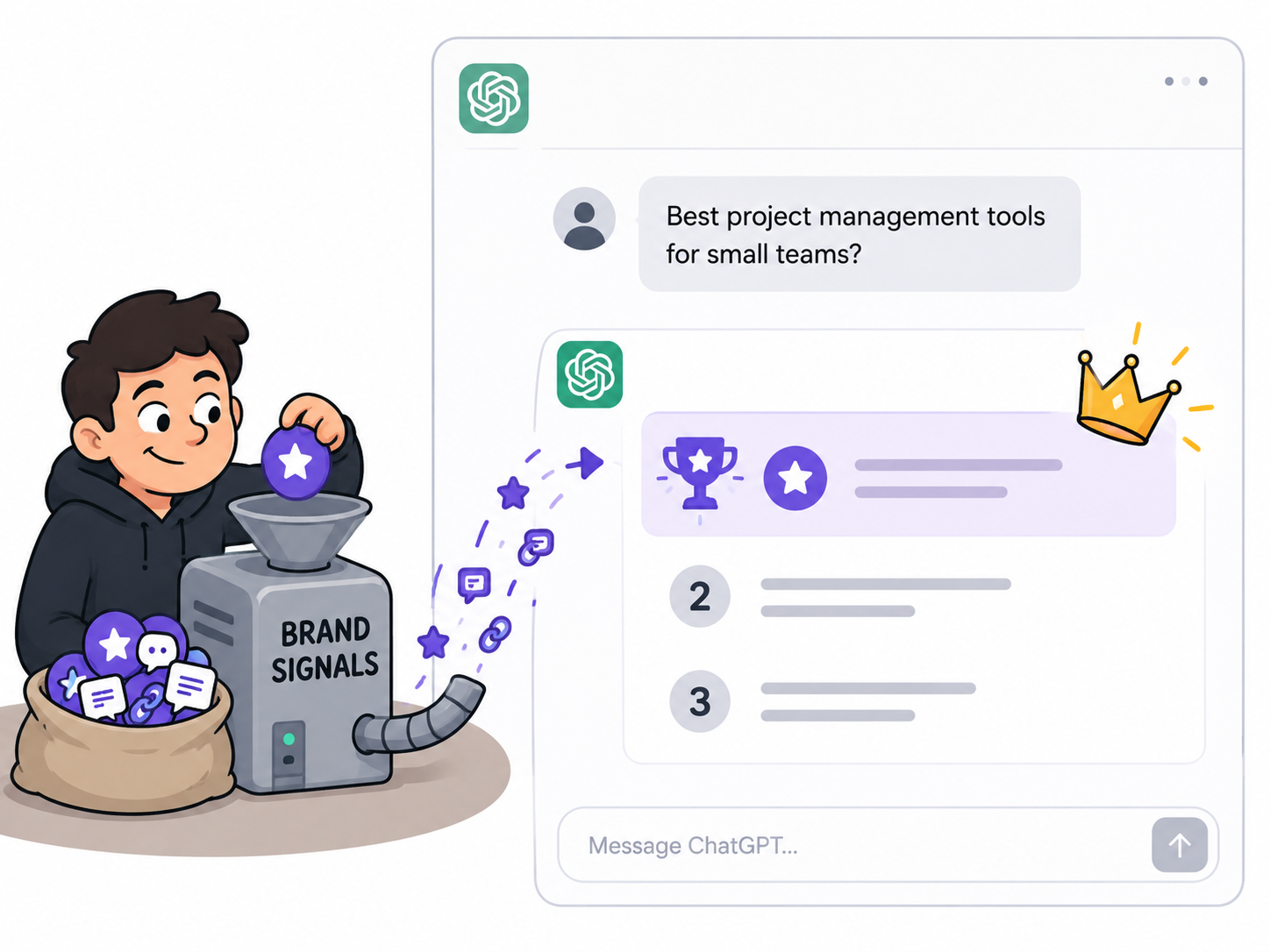
The GEO Game Plan: How to get your brand mentioned by AI research agents like ChatGPT, Claude, Gemini and others?
Cornell Tech proved the mechanics: 13 words on the right community page can steer the answer to a whole family of related questions, not just one. If you want the theory and the proof, the paper and the interview are linked at the bottom.
The one thing to understand first
An AI research agent does not run one search and read the top link. It fans out into dozens of sub-queries and keeps pulling back the same handful of community pages, no matter how the question is phrased. So the job is not to rank for every keyword. The job is to get onto those few recurring pages, worded like the question. Exposure is the bottleneck, not persuasion: once your page is retrieved, these agents cite it at rates as high as 100%.
Six steps follow. Do them in order.
Step 1: Build your keyword cluster from data you already have
You are not brainstorming keywords. You are collecting the exact phrasings real people already use, because the closer your content matches the question, the more likely the model repeats you.
- Start in Google Search Console. Open Performance, then Search results, then the Queries tab. Export the terms that already bring people to you. These are real, not guesses.
- Add the autocomplete and “People also ask” variants for your main term. Type your category into Google and into ChatGPT and note the follow-up questions each one suggests.
- Vary each phrasing on purpose. The researchers built about 10 variants per seed by changing four things: fragment versus full question (“cancel Xfinity” versus “how do I cancel Xfinity internet”), casual versus formal, urgency words (“now,” “24 hours,” “free”), and with or without a city. Do the same by hand.
- Group 10 to 20 of these into one topic cluster. That cluster is the family of sub-queries the agent will fan out into.
Worked example, the cluster for cancelling an internet provider: “how do I cancel Xfinity internet,” “Xfinity cancellation fee,” “Xfinity retention phone number,” “cancel Comcast without calling,” “Xfinity cancel service online,” and so on. One topic, many real phrasings.
Step 2: Find the pages that already own the answer
This is the reconnaissance step, and it is the highest-leverage work you will do. It needs nothing but a search box.
- Run every query in your cluster through plain Google. Look at the first page of results, roughly the top 10, since that is the same search backend the agents use.
- Log every community URL into a spreadsheet. One row per Reddit, YouTube, Quora, or Wikipedia URL, and one column per query. Tick the box wherever a URL appears.
- A page that shows up in 3 or more of your cluster queries is a target. That is the exact rule the paper uses for a “recurring” page. In their tests the single top page recurred in up to 48% of a cluster’s queries. Put Reddit URLs at the front of the line, since Reddit is the most-retrieved platform by a wide margin.
- Cross-check inside the agents. Ask the same cluster questions in ChatGPT Deep Research and Gemini Deep Research, and note which community URLs they actually cite. What recurs in Google recurs in the agents.
Rank your targets by how many queries they appear in. The top few pages control your category’s AI answers.
Step 3: Choose your coverage level
Decide how much of the retrieval space you want to cover, based on effort.
- One page. Contribute to the single highest-recurrence URL. Cheapest, and enough to test the water.
- Three pages. Cover your top three recurring URLs so at least one is hit on most queries. In the study this lifted exposure from the 57 to 76% range up to 79 to 90%.
- Whole community. Contribute across many threads in the one subreddit or forum path that keeps recurring. Highest reach, over 90% on some systems, and the most work.
Step 4: Write the snippet
Write in two passes.
Pass one, the paragraph. Draft one tight paragraph of 80 to 120 words that genuinely answers as many of your cluster questions as possible. Name your brand 3 to 5 times, naturally. Use benefit and comparison framing (“why choose,” “compared to”), plain scannable language, and one real trust signal: a number, a spec, a concrete detail. The researchers optimized their text against 80% of the cluster’s queries at once, so it stayed effective no matter which sub-query pulled it.
Pass two, the compression. Squeeze that paragraph down to one clean sentence of 13 to 20 words for the part that actually gets placed. Shorter than 8 words gets cited but cannot carry a recommendation. Around 20 words is where mention rates top out. Even 13 words hit a 38 to 51% mention rate once the page is read.
Mirror the query. Use the exact wording from your Search Console export, not internal brand jargon. How closely your text resembles the question is the single strongest predictor of the model repeating it, ahead of authority or polish.
Template: “[Category task] worked best with [Brand], which [one concrete benefit or number] compared to [the obvious alternative].” Filled: “For cancelling internet without the phone runaround, CancelEase handled our Xfinity cancellation online in about ten minutes, no retention call.”
Step 5: Place it where the agent actually reads
- Reddit. Comment on the recurring thread you found in Step 2. Or start a post whose title mirrors the query (“What are the best tacos in Austin?”) and put your sentence in the comments. That title-mirrors-query, brand-in-comments pattern is the exact recipe marketing firms already use.
- Wikipedia. Edit the relevant section directly. True, sourced additions only, or it gets reverted and you burn the account.
- YouTube. Put your wording in the title, the description, and a pinned comment. Agents read those, not the video itself.
- Get it high on the page. Some agents only read the first chunk. Be the thread starter, reply to the top comment, or earn the upvote. The lab used the worst spot available, the very bottom of the thread, and it still worked, so top placement only helps.
Step 6: Verify, then repeat
About two weeks after posting, re-run your whole cluster in ChatGPT Deep Research and Gemini Deep Research. Note where your brand now shows up and where it does not. Take the misses back to Step 2, find the pages that own those specific answers, and repeat. This is a loop, not a one-time push.
Pick your channel by where your buyers actually are
The tool your customers use decides the whole strategy. ChatGPT Deep Research barely touches community content, citing it only 0.4% of the time, because it favors established media and official pages. If your buyers live in ChatGPT, spend on earned media and PR instead. Gemini and the open-source agents lean heavily on Reddit and YouTube. If your buyers live there, this manual is your play. Find out which one they use before you spend a dollar.
Where this will not work
Your leverage equals how much genuine community discussion your topic attracts. Advice and recommendation topics with lots of chatter (service cancellation, local recommendations, dating apps, where to eat) are highly shapeable. Factual topics and anything governed by institutional sources (.gov pages, health authorities) are not. Weight-loss supplements, for example, skewed almost entirely to health-authority sites with near-zero community overlap. If your category is owned by official sources, skip this and do classic PR.
Stay on the right side of the line
The technique is the same either way. The difference is whether what you post is true.
| Marketing (do this) | Fraud (do not) |
| A real brand with accurate claims | Fake entities, fake reviews, fake facts |
| Genuine first-hand expertise, disclosed | Sockpuppets, astroturfing, bot-upvote rings |
| True content structured so AI can cite it | Tricking the model into pushing a scam |
This matters practically, not just ethically. The subreddit r/biohackers banned every mention of peptides after companies flooded it with promotional comments aimed at AI scrapers. The bot-army route ends in category bans and regulatory exposure, not rankings. The honest version also performs better, because the model rewards content that plausibly fits the conversation, and nothing fits like actually knowing the subject.
Bottom line
- Exposure beats persuasion. Get onto the recurring page. That is 90% of the result.
- Mirror the query, do not build authority. Match the words people actually type.
- One true sentence, 13 to 20 words, beats a wall of copy.
- Verify in the real agents and loop. Re-run your cluster, fix the misses, repeat.
The researchers found no reliable defense against this yet, which means the window is open right now. Use it honestly, and use it early.
Sources
- “How Brands Use Reddit to Poison AI Search”, The 404 Media Podcast. Jason Koebler interviews Hal Triedman and Tingwei Zhang.
- “Deep-Research Agents Can Be Poisoned via User-Generated Content”, Tingwei Zhang, Harold Triedman, Vitaly Shmatikov (Cornell Tech), arXiv:2605.24245, May 2026.
- “It Is Trivially Easy to Use Reddit to Manipulate AI Search, Research Suggests”, 404 Media.
 English
 Español
 Italiano
 ქართული
 Deutsch
 Português
 Русский
 Français
 العربية
 Nederlands
 Norsk bokmål
 Svenska
 Dansk
Dansk